
Best Mobile Tire Service Dallas Providers (2026)
A tire blowout on I-35 with a full load doesn't give you time to call a tow and wait at a shop. You need someone who comes to you, fast. This guide breaks down the best mobile tire service providers across Dallas, who each one is built for, and why some matter far more to fleet operators than others.
1. The Tire Specialist , Our Top Pick for Commercial & Fleet Mobile Tire Service in Dallas
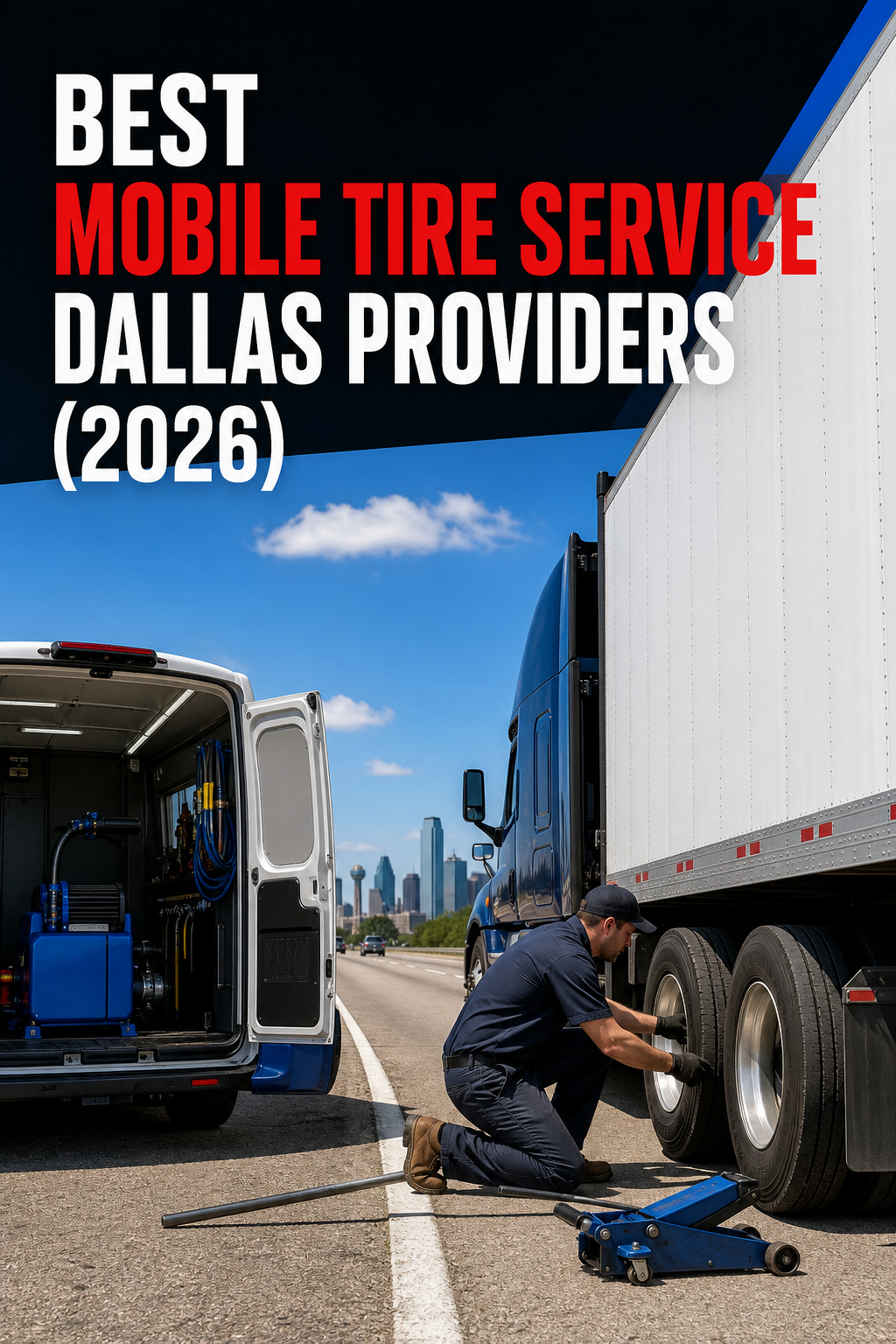
We're the top pick here, and here's why: The Tire Specialist is one of the only mobile tire providers in the DFW area that focuses exclusively on commercial trucks and fleet vehicles. No passenger cars. No EVs. Just the heavy equipment that costs real money when it sits still.
Our team handles on-site tire repair, replacement, and roadside assistance as a single bundled offering. That matters. Many competitors separate those services, which means more calls, more coordination, and more downtime for your drivers. We bring everything in one dispatch.
We cover the full Dallas-Fort Worth metro, including areas like Irving, Garland, Lancaster, Hutchins, Mesquite, Plano, and Sunnyvale. Whether your rig is on a loading dock, parked at a job site, or stuck on I-635, we roll out to your location. Our mobile units carry the tools and tires to handle most issues without a second trip.
Fleet managers specifically benefit from our on-site tire maintenance visits. We inspect every tire, measure tread depth and pressure, patch repairable punctures, and document everything for your records. That on-site documentation turns reactive emergency calls into a scheduled maintenance history , which directly reduces surprise breakdowns and missed deliveries.
Best for:Commercial truck operators, fleet managers, logistics companies, and any DFW business running multiple vehicles on tight schedules.
The honest caveat: we don't publish a specific response-time guarantee on our site, so if you're comparing us on speed claims alone, ask directly. Our focus is on getting the job done right, not overpromising on arrival windows we can't always control on busy Dallas roads.
Key Takeaway:The Tire Specialist is the only Dallas mobile tire provider built exclusively around commercial trucks , making it the clearest choice for fleet operators who can't afford generalist service.
2. Around-the-Clock Mobile Tire Repair Services, Best for Roadside Blowouts Any Hour
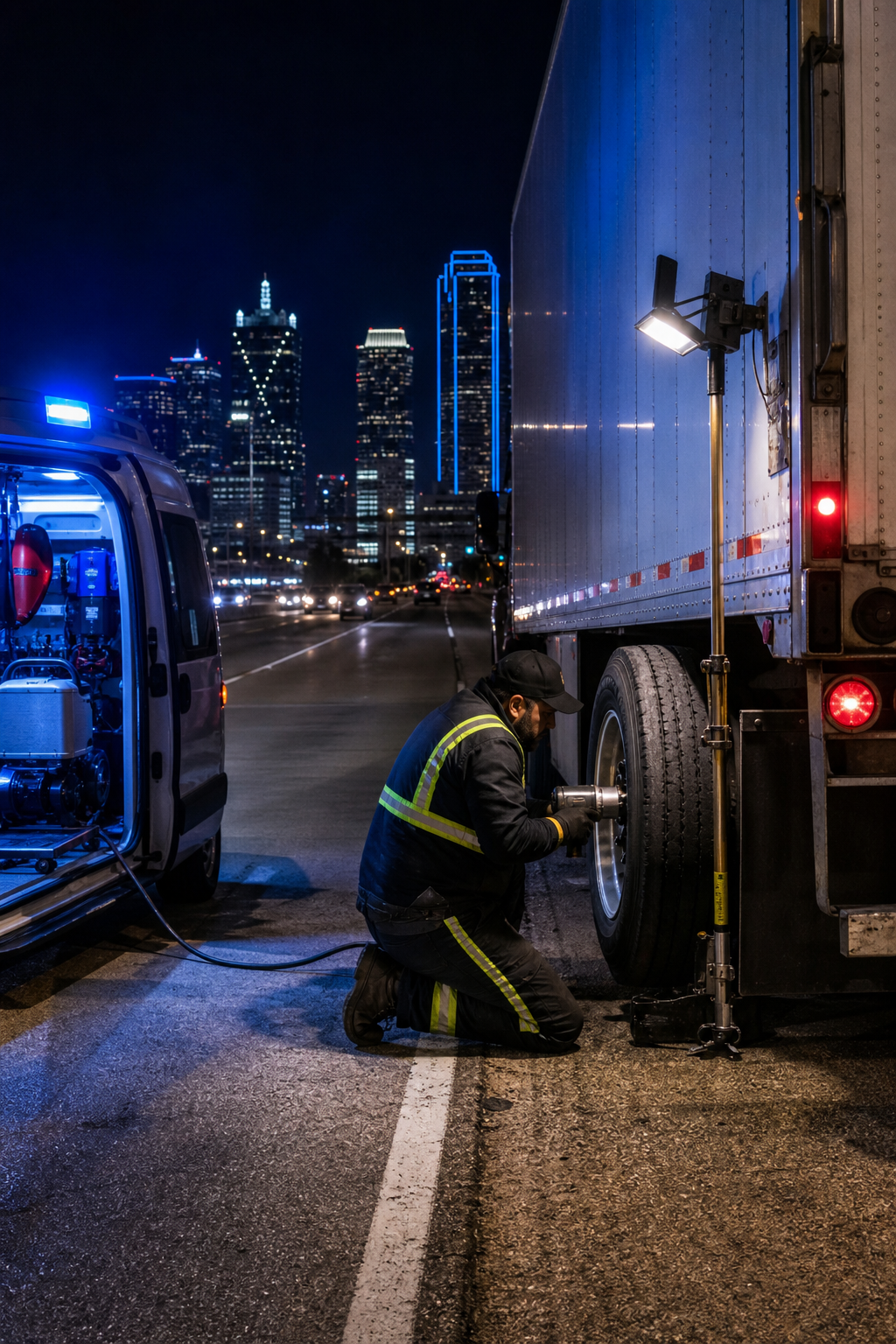
Some blowouts happen at 2 a.m. on a route that can't wait until morning. That's when around-the-clock emergency mobile tire repair services earn their place on this list.
In the Dallas market, a handful of providers advertise around-the-clock availability for passenger and light commercial vehicles. Based on the research we've compiled, three providers among those studied disclose a response-time claim, averaging about 40 minutes. That's a meaningful benchmark when your driver is stranded on a dark stretch of highway.
These services typically handle flat repair, valve stem replacement, and single-tire swaps. They work well for solo drivers, rideshare operators, and light-duty trucks. The core offering is speed and accessibility, not specialization. If you need someone on-site within the hour for a car or cargo van, this category delivers.
For drivers who want to understand what a technician looks for on arrival, the tire's structural components , sidewall, bead, tread , each tell a different story about damage and repairability. A good emergency tech makes that call on the spot.
Watch out for:Some providers that advertise 24/7 coverage only dispatch within a limited radius after midnight. Always confirm your specific location is covered before you're in a bind, not after.
3. Fleet & Commercial Truck Tire Services, Best for High-Volume Dallas Operators
High-volume operators running 10, 20, or 50 trucks don't have time to call a different vendor every time a tire goes down. They need a fleet maintenance program with scheduled yard visits, tire tracking, and a single point of contact.
This category of provider typically offers recurring on-site inspections, pressure checks across an entire fleet, rotation scheduling, and documentation that feeds into your maintenance records. The value isn't just the repair , it's the prevention. Identifying a tire with irregular wear patterns before it fails on I-20 saves the cost of an emergency call, plus the downstream cost of a delayed delivery.
When evaluating fleet-focused providers, ask two questions directly: Do they carry inventory for your specific truck models? And do they offer a dedicated fleet account with documented service history? Providers that answer yes to both are genuinely built for high-volume work. Providers that hesitate are likely general-service shops with a fleet program as an afterthought.
Our mobile tire services for commercial trucks in Dallas include fleet maintenance visits designed around exactly this kind of recurring, scheduled care. Certified technicians, full documentation, and coverage across the DFW metro.
One operational pattern worth knowing: uneven tire wear on a commercial rig often points to alignment or suspension issues, not just inflation. A fleet program that only checks pressure misses half the picture. Look for providers whose technicians actually read the wear patterns and flag mechanical issues alongside tire ones.
4. Mobile Tire Inspection & Preventive Maintenance Services, Best for Avoiding Downtime
Most tire failures give you warnings weeks before they become emergencies. The problem is that most drivers and fleet managers don't know what they're looking at. On-site inspection services exist to close that gap before it costs you.
A proper mobile inspection covers more than a visual glance. The technician runs their hand along the tread to feel for cupping, feathering, or bald patches , each of which points to a different underlying problem. Sidewall cracks, especially the spiderweb pattern that signals dry rot, spread fast in Texas heat. One sharp turn with a compromised sidewall under a full load can turn a five-minute inspection into a costly breakdown.
Pressure readings matter too. Underinflation wears the shoulders. Overinflation beats the center. Misalignment chews one edge. A technician who records readings across every axle and compares them over time builds a picture of how your fleet is actually being used , and abused.
The on-site tire repair and replacement services we offer include exactly this kind of documentation-driven inspection. We come to your yard, measure pressures and tread depth, remove and patch repairable punctures, and advise on replacements. We also flag alignment concerns if the wear patterns point that way.
Pro Tip:Run a 30-second visual check per tire every week , sidewall for cracks, tread for embedded debris, and a pressure gauge reading. Do it before long hauls. That routine alone reduces emergency roadside calls significantly over time.
The limitation to watch for in this category: some providers offer inspections as a standalone upsell, then hand off any actual repair to a different crew or a fixed shop. Look for providers who handle inspection and repair in the same visit. Splitting those steps adds delay and communication gaps that fleet managers don't need.
5. Road Hazard & Flat Repair Services, Best for Pothole and Debris Damage
Dallas roads are genuinely tough on tires. Construction zones on I-35, I-635, and US-75 scatter nails, screws, and rebar fragments across lanes on a regular basis. One driver caught a pothole on 635 hard enough to shred a sidewall completely , a single-tire replacement that could have been a five-minute plug if caught as a slow leak first.
Road hazard specialists focus on fast diagnosis and repair of puncture damage. The key question they answer on arrival: is this tire pluggable, or does it need replacing? A nail in the center groove with no sidewall involvement is typically repairable. A sidewall split or a puncture within the last inch of the shoulder usually isn't. Good road hazard technicians make that call quickly and honestly, without pushing an unnecessary replacement.
For Dallas operators, this matters more than in most cities. High-construction urban corridors like the DFW metro are consistently tough environments for tire wear, and pavement conditions in active construction zones directly increase the risk of puncture damage.
When a flat happens mid-route, the priority is getting the vehicle moving again without compromising safety. A road hazard specialist who carries a full inventory of patch materials and common commercial tire sizes handles that faster than a general-service provider who has to order stock.
If you're running commercial vehicles through the north Dallas construction corridors regularly, it's worth asking any provider you consider: what's your average patch-and-go time for a center tread puncture? That single number tells you a lot about how prepared their service vehicles actually are.
6. Full-Service Roadside Assistance Providers, Best for More Than Just Tires
Sometimes a tire isn't the only thing that's gone wrong. A driver stranded at 11 p.m. with a flat and a dead battery needs more than a tire swap. Full-service roadside assistance providers handle tires plus adjacent emergencies — jump-starts, fuel delivery, lockouts, and in some cases light mechanical triage.
This category is best for passenger vehicle operators, individual commercial drivers who don't have fleet backup, and businesses that want a single vendor covering multiple roadside scenarios. The tradeoff is specialization. A provider built to handle 15 different service types across all vehicle classes typically doesn't bring the same depth of commercial tire inventory or heavy-duty expertise as a dedicated commercial tire specialist.
For fleet managers running semi-trucks, this category is usually a supplement, not a primary solution. You might use a full-service roadside provider for your company cars or light vans while keeping a dedicated commercial tire specialist on call for the heavy iron.
The most common structure in this space: a network-based dispatch model where a central coordinator routes your call to the nearest available technician. Response times depend heavily on where in the DFW metro you're stranded and what time it is. Coverage is broader, but depth of service varies by the individual tech dispatched.
If you manage a mixed fleet with both commercial trucks and lighter vehicles, it makes sense to have both types of providers in your contacts — one focused, one broad. Don't try to make one service do both jobs well.
What to Look for When Choosing a Mobile Tire Service in Dallas
The right provider depends on your vehicle type, how often you need service, and whether you're making a one-time emergency call or building a long-term fleet maintenance relationship. Here's a checklist that cuts through the noise.
Factor | Why It Matters | What to Ask |
Vehicle specialization | Commercial trucks need different tools and expertise than passenger cars | Do you service commercial trucks and trailers specifically? |
Service bundling | Repair, replacement, and roadside in one visit reduces coordination time | Can one technician handle repair and replacement on the same call? |
Response time disclosure | Undisclosed response times are a red flag for reliability | What's your average arrival time in [your area of Dallas]? |
Service area coverage | DFW is large — confirm they cover your routes, not just central Dallas | Do you cover [specific corridor or city like Lancaster or Mesquite]? |
Documentation & records | Fleet maintenance history reduces breakdown risk over time | Do you provide written service records per vehicle? |
24/7 availability | Tire emergencies don't follow business hours | Is after-hours coverage the same technician quality, or a third-party dispatch? |
Certification | TIA certification signals proper training on commercial tire standards | Are your technicians TIA-certified? |
One thing to watch across all provider categories: only about 40% of mobile tire providers in the Dallas market disclose certifications on their websites. That doesn't always mean uncertified , but it does mean you should ask directly rather than assume. A provider who can immediately name their tech's certification level is more organized than one who has to check.
For fleet operators specifically, the most important question is about preventive maintenance cadence. If a provider only shows up when something breaks, they're reactive. If they offer scheduled yard visits with documented tire tracking, they're a genuine partner. That difference shows up in your maintenance budget over a full year of operation. For more on what those visits typically include, our guide on mobile tire service response times and dispatch processes in Dallas breaks down what to expect from start to finish.
Frequently Asked Questions
Can a mobile tire service handle commercial truck tires, not just passenger cars?
Yes , but not every provider carries the equipment or inventory for it. Providers like The Tire Specialist focus exclusively on commercial trucks and fleet vehicles, which means their service vehicles are stocked for heavy-duty tires and large rims. General mobile services often handle only passenger cars and light trucks, so always confirm the vehicle class before booking.
How fast do mobile tire services in Dallas typically arrive?
Among providers that disclose arrival times, the average in the Dallas market sits around 40 minutes. That figure varies based on your location in the DFW metro, time of day, and how close the nearest dispatched technician is. During peak traffic hours on corridors like I-35 or the LBJ Freeway, expect the longer end of any estimated window.
What's the difference between a plug repair and a tire replacement on a commercial truck?
A plug or patch repair works when the puncture is in the center tread area and the sidewall is intact. If the damage is within about an inch of the shoulder, on the sidewall itself, or if the tire shows dry rot or structural cracking, replacement is necessary. A qualified technician makes this call on-site after a full visual and physical inspection of the tire.
Do mobile tire services in Dallas work on fleet vehicles at a yard or job site?
Yes. Most commercial-focused mobile tire services will come directly to your fleet yard, loading dock, or job site rather than requiring you to bring vehicles to them. This is one of the primary advantages over a fixed shop , maintenance happens where your trucks already are, which cuts the time drivers spend off-route for tire service.
What should I have ready when I call for emergency mobile tire service?
Have your exact location , a GPS pin or cross streets are better than an address on a highway service road. Know your vehicle type and tire size if possible, and be ready to describe the damage. Whether it's a slow leak, a blowout, or sidewall damage affects what tools and tires the technician needs to bring, which speeds up the whole service call.
Is preventive tire maintenance worth scheduling for a small fleet?
Yes, even for fleets of three to five trucks. Scheduled inspections catch uneven wear, pressure issues, and embedded debris before they cause a roadside failure. The cost of one emergency callout , including driver downtime and potential delayed delivery penalties , typically exceeds the cost of several preventive visits. Building a maintenance cadence early saves money at scale.
Conclusion
For commercial trucks and fleet vehicles across the DFW metro, The Tire Specialist is our clear recommendation , the only mobile provider in this market built exclusively around heavy-duty commercial work, with bundled on-site repair, replacement, and fleet maintenance in a single service. If you're managing a fleet and want a partner who treats your uptime as seriously as you do, the next step is simple: visit our full breakdown of the best mobile tire service options in Dallas to see how the options compare and book the right fit for your operation.


Comments