
Roadside Assistance Dallas: Step-by-Step Guide
- 2 days ago
- 8 min read
A truck breakdown can turn one bad tire into hours of lost route time. The right response starts before the service truck arrives. We’ll show you how to secure the scene, choose roadside assistance in Dallas, share the details dispatch needs, and confirm the repair before putting the truck back to work.
Table of Contents
Step 1: Secure the Truck and Assess the Scene
Need roadside assistance in Dallas? Start with safety. A disabled truck near a busy lane is a hazard for your driver, passing traffic, and the service team.
Move the truck as far from traffic as the damage allows. Do not drive on a flat or badly damaged tire if doing so could harm the wheel or cause the truck to lose control. Set the parking brake, turn on the hazard lights, and place warning devices only if your driver can do so without stepping into live traffic.
On a highway shoulder, the driver should stay inside the cab when it is safer there. If the truck is in an unsafe position, move behind a guardrail or another solid barrier. Never stand between the truck and passing vehicles. A second impact can happen fast.
Look for immediate risks before anyone checks the tire. Watch for smoke, leaking fuel, fire, loose cargo, or a damaged wheel. If there is a fire or serious crash, use emergency services first. Tire service comes after the scene is safe.
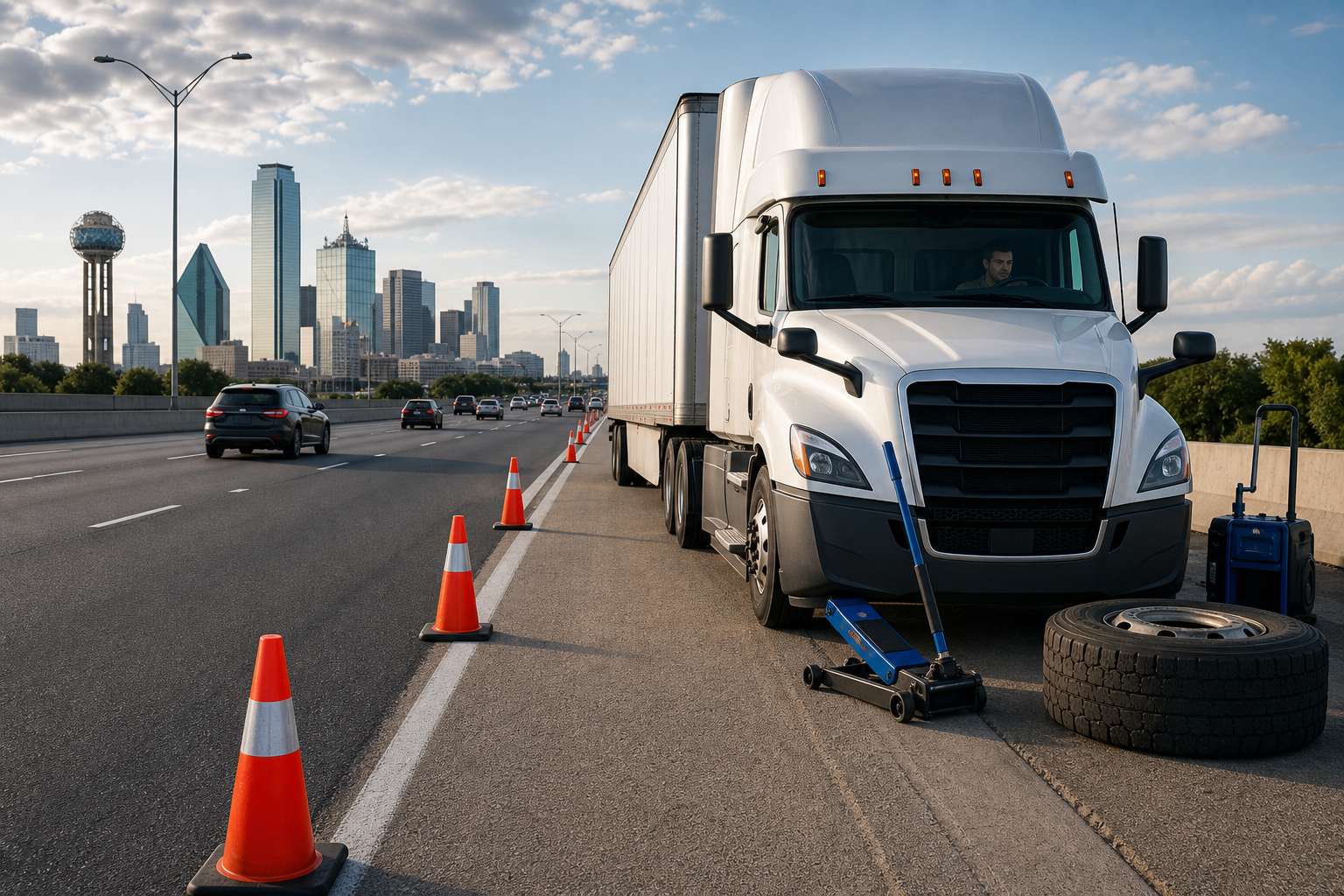
Before you contact a provider, note the basic problem. Is the tire flat, blown out, leaking air, or damaged at the valve? Is the truck leaning? Can it move safely to a wider shoulder or nearby lot? These answers help dispatch send the right equipment.
Key Takeaway:Protect the driver first, then protect the truck. A precise safety check prevents a tire problem from becoming a roadside collision.
By now, the truck should be stable, the driver should be in a safe position, and the main hazard should be clear.
Step 2: Call the Right Dallas Roadside Assistance Provider
Need roadside assistance Dallas fleets can use after hours? Choose a provider that works on the vehicle in front of you. A passenger-car service may not have the tools, tire sizes, or crew needed for a commercial truck.
For fleet vehicles, we recommend starting with 24-hour roadside tire service for commercial trucks . The Tire Specialist focuses on on-site repair, tire replacement, and roadside assistance for commercial trucks and fleet vehicles across Dallas-Fort Worth.
That focus matters when a driver has a blowout on a loaded trailer. The provider needs to understand the truck type, the tire position, and the work space needed around a heavy vehicle. A provider built around passenger cars may not be the best fit for that call.
We also suggest asking four direct questions before dispatch:
Do you handle this truck class and tire size?
Can you repair the tire or replace it on-site?
Do you serve the truck’s current corridor?
Can you give the driver a clear dispatch update?
Speed matters, but speed alone does not settle the choice. Check the provider’s stated vehicle coverage before dispatch.
Mobile Diesel Truck Repair reports 24/7 coverage, ASE-certified technicians, and a formal fleet program. It also reports a 40 minute average response. That contrast shows why fleet managers should check both specialization and response claims. Certification can speak to training, but it does not promise the fastest arrival.
For a broader look at local service types, our Dallas mobile tire service provider overview can help you compare fleet fit with general roadside coverage.
Use the provider’s official service page or dispatch channel. Avoid choosing based on a search result alone. The fastest listed response may still be a poor match if the technician cannot handle the truck.
By now, you should have a provider that fits the vehicle, the route, and the type of tire failure.
Step 3: Share Exact Location and Vehicle Details
Roadside assistance Dallas dispatchers work faster when they receive a usable location. “I’m on I-35” is not enough. Dallas has several major routes, frontage roads, ramps, exits, and frontage lanes that can look alike.
Send a GPS pin when possible. Then add a short written description. Include the highway name, direction of travel, nearest exit, mile marker, cross street, and the side of the road. If the truck is in a lot, name the lot, gate, row, dock, or nearby building.
We want dispatch to know where the service truck can safely stop. A pin near a highway may land on the wrong side of a divided road. Tell the dispatcher whether the truck is on the main lanes, shoulder, frontage road, ramp, warehouse yard, or parking lot.
Share these vehicle details:
Truck type, such as tractor, trailer, box truck, or fleet van.
Unit number and trailer number, if available.
Axle or tire position, such as left steer or outside drive tire.
Tire size and brand, if the driver can read the sidewall safely.
Damage type, such as puncture, sidewall failure, valve leak, or blowout.
Load status and whether the truck can move.
Do not ask the driver to walk near traffic to read a tire sidewall. The truck number and a photo from a safe position may be enough for the first dispatch. The service team can confirm the tire once it arrives.
A location should also include access limits. Tell us if the truck is under a low bridge, inside a garage, behind a locked gate, or on soft ground. A mobile unit needs room to position safely. Poor access can change the work plan.
Dallas covers a wide metro area, so a clear pin reduces back-and-forth questions. We can also use a location description as a backup if the driver’s device has a weak signal. Roadside map tools can contain outdated details, so confirm the route with the driver before the technician leaves. Roadside map guidance also warns that route details and site conditions can change, which is a useful reminder to verify the live scene.
Pro Tip:Ask the driver to send one safe photo of the truck’s position and one close photo of the damaged tire. Never ask for a photo that requires standing in traffic.
Write the dispatch details into the fleet record. That gives the manager a clean handoff if another person takes over the call. By now, the provider should know what vehicle is involved, where it sits, and what equipment the technician may need.
Step 4: Stay Safe While Help Is on the Way
While roadside assistance is coming, keep the driver away from the work zone. A service truck may arrive with warning lights, but passing traffic can still move close to the shoulder.
Have the driver remain in the cab when that is the safest option. If the truck is in a dangerous position, the driver should move behind a guardrail or another barrier. Do not stand beside the truck, sit on the shoulder, or wait near the damaged tire.
Keep the cab doors closed when traffic is close. Ask the driver to watch for the service vehicle from a safe place rather than walking toward it. Give the technician a clear description of the truck’s color and unit number so the technician can identify it without putting the driver at risk.
Do not attempt a roadside repair unless the area is safe and the person doing the work has the right training and tools. Heavy truck tires carry high stored energy. A damaged tire, wheel, or rim can fail during removal. That is a job for trained service staff.
If the truck carries hazardous goods, tell dispatch before arrival. Share any fire, spill, crash, or cargo concern. Keep bystanders away from the truck. If the scene worsens, update emergency responders and the roadside provider.
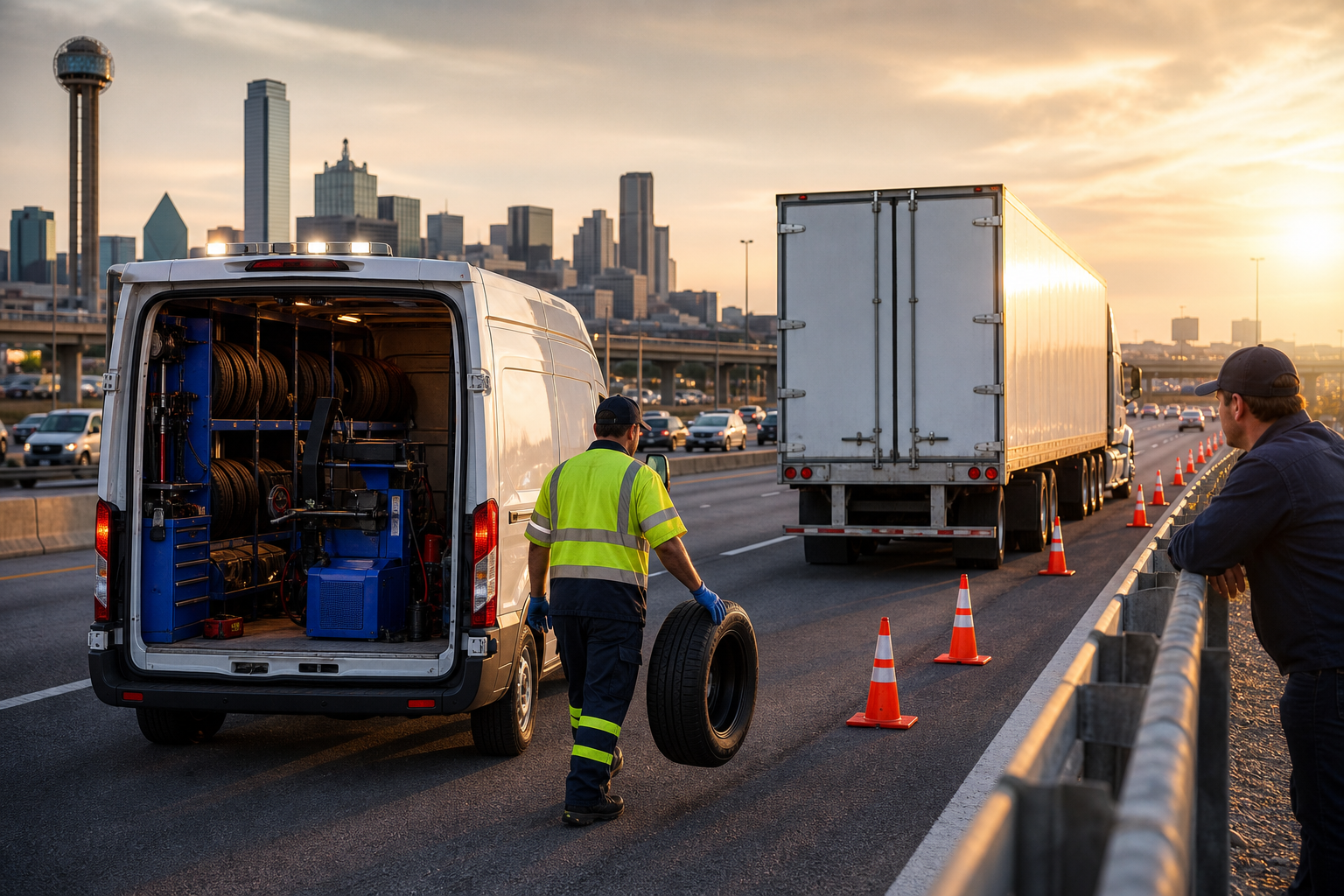
Keep the dispatch line available for updates, but do not make the driver handle a phone while near traffic. A fleet manager can relay messages from a safe location. If the estimated arrival changes, pass the update to the driver without asking them to leave the cab.
These steps may feel slow when a route is already late. They are still the right trade. A few minutes spent behind a barrier is better than exposing a driver to a second crash.
Step 5: Confirm the Repair and Return the Vehicle to Service
Before roadside assistance is complete, confirm that the repair fits the truck’s next move. A tire that looks fine from a distance may still have internal damage or a leaking valve.
Ask the technician to explain what failed and what work was done. If the tire was repaired, ask whether the damage was suitable for repair. If it was replaced, confirm the tire size and position. The driver should not leave until the wheel and tire are ready for normal operation.
We also recommend a short return-to-service check:
Confirm the replacement tire matches the required size.
Check that the wheel hardware is secure.
Ask whether tire pressure was checked.
Look for air leaks around the valve and bead.
Confirm that no tools or loose parts remain near the truck.
Record the service details in the fleet maintenance program.
A fleet maintenance program is the record your team uses to track tire work, inspections, and future service needs. Add the unit number, date, location, tire position, failure type, and action taken. Include photos when your system allows them.
This record can reveal repeat problems. Several failures on the same axle may point to alignment, load, pressure, or route issues. A tire that fails after contact with road debris may need a different follow-up than a tire with repeated low pressure.
Ask the driver to begin slowly after the repair. They should watch for vibration, pulling, warning lights, or a change in handling. If something feels wrong, stop in a safe place and contact the provider again.
The Tire Specialist can support this workflow with on-site repair, replacement, and roadside assistance for commercial trucks and fleet vehicles. That gives a fleet manager one clear path for a tire emergency instead of sending the driver to search for a shop while stopped.
Close the event only after the driver confirms safe movement and the manager has the service details. That final check turns a roadside incident into useful maintenance data.
FAQ
What does roadside assistance in Dallas cover for commercial trucks?
Roadside assistance in Dallas may cover commercial tire repair, on-site tire replacement, and help with a disabled truck. The exact service depends on the provider and vehicle type. Before dispatch, confirm that the provider handles your truck class, tire size, and location. For fleet work, ask how the service record will be sent back to your manager.
How do I find roadside assistance for a semi truck in Dallas?
Look for a provider that states it works with commercial trucks and fleet vehicles. Then verify the truck type, tire position, service area, and after-hours coverage. The Tire Specialist focuses on mobile commercial tire service across Dallas-Fort Worth. Share the truck’s location and tire details before the technician leaves.
What information should I give roadside assistance dispatch?
Give dispatch a GPS pin plus the highway, direction, exit, and nearby landmark. Add the truck type, unit number, tire position, tire size if safe to read, and damage type. Also explain whether the truck can move and whether access is limited. These details help the provider send the right mobile equipment.
Is it safe to change a commercial truck tire on the shoulder?
Changing a commercial truck tire on a shoulder can be dangerous, especially near fast traffic. Keep the driver behind a barrier or inside the cab when possible. Heavy tires and damaged wheels also need trained handling. Secure the scene first, then let a qualified roadside technician decide how to perform the work.
When should a truck return to service after tire repair?
A truck should return to service only after the technician confirms the tire and wheel are ready for travel. Check the tire size, pressure, wheel hardware, and signs of an air leak. Have the driver move slowly at first. Record the repair in the fleet maintenance program before closing the incident.
Conclusion
For a commercial truck breakdown, choose a provider that understands fleet vehicles and can work on-site. Secure the truck, send an exact location, and confirm the repair before the driver leaves. When you need a Dallas-Fort Worth partner for mobile commercial tire help, start with The Tire Specialist and keep its service details in your fleet response plan.


Comments