
DOT Tire Requirements: Commercial Truck Guide
- 1 day ago
- 5 min read
A single $19,277 fine can shut a truck down for a day. That’s why we walk you through the exact steps to stay compliant with DOT tire requirements and keep your fleet moving.
Table of Contents
Step 1: Check the Tire Sidewall and DOT Code
The sidewall tells you everything you need to know about a tire’s legal status. Look for the DOT symbol, the Tire Identification Number (TIN), size, load rating, and the maximum cold‑inflation pressure.
First, locate the DOT code. It starts with "DOT" and ends with a four‑digit date code , the last two digits are the year of manufacture. A tire made after 2000 shows the week and year. Wikipedia explains how the code works, and it’s the quickest way to verify that the tire meets federal safety standards.
If the code is missing on one side, flip the tire and check the other side. Once you have the date, compare it to the fleet’s age policy. Tires should be evaluated for replacement after six to ten years, depending on usage, storage conditions, and manufacturer recommendations, even if the tread looks fine.
We often see drivers skip this step because they assume the tire is fine if it looks good. That gamble can cost a fine and a delayed delivery. Our mobile crew can read the code on‑site and log it in your DVIR system, so you never lose track.
Need a deeper dive on selecting the right tire for each axle? Check out our Best Truck Tires Guide: How to Choose the Right Tires for Your Fleet . It walks you through load indexes, speed ratings, and the best tire families for different routes.
Step 2: Measure Tread Depth for Every Axle
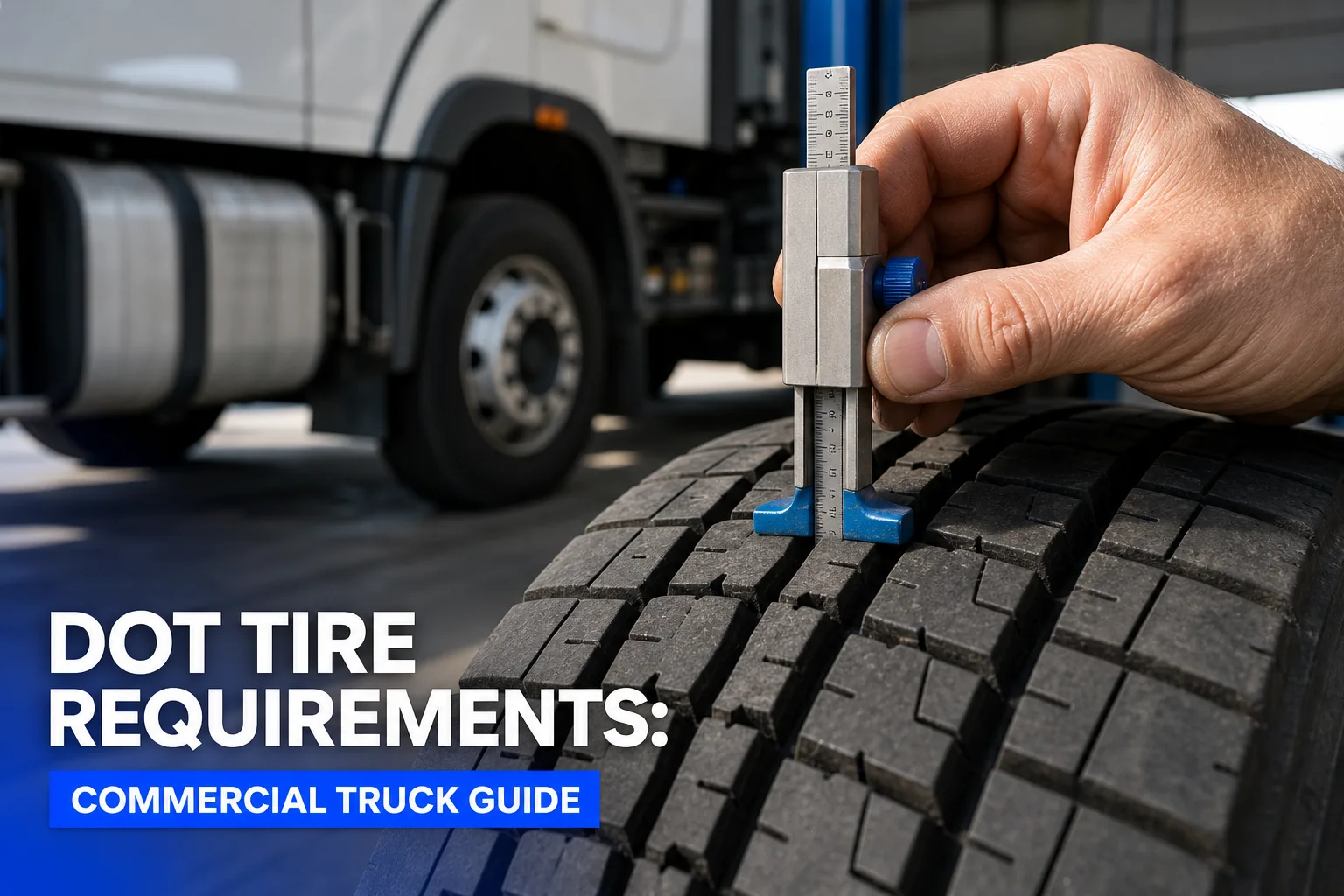
Commercial trucks must maintain at least 4/32" of tread depth on steer (front) tires and 2/32" on drive and trailer tires. Inspectors measure the shallowest groove, not an average, so you must check every major tread channel.
Grab a tread‑depth gauge, make sure the scale reads in 32nds of an inch. Press the probe straight into the deepest part of the groove, read the number, and record the lowest reading for that tire.
Do this for each tire on the vehicle. If any steer tire reads below 4/32", it’s out‑of‑service the moment you hit the road. The same rule applies to drive and trailer tires at 2/32". A single worn spot can create an inspection issue.
Here’s a quick reference table you can print and stick in the shop:
Axle Position | Minimum DOT Tread Depth | Typical Replacement Target |
Steer (front) | 4/32" | 5/32" – 6/32" for safety margin |
Drive (rear on tractor) | 2/32" | 3/32" – 4/32" for longer life |
Trailer (tandem) | 2/32" | 3/32" – 4/32" to avoid surprises |
Keep the gauge clean and verify its calibration every few months. A dirty probe can give a false high reading and let a worn tire slip through.
Want to know the exact moments you should pull a tire from service? Our When to Replace Truck Tires: Essential Guide for Fleet Safety breaks down the mileage and condition cues that matter.
Step 3: Verify Inflation Pressure Before Dispatch
Underinflated tires are a hidden danger. Tire pressure must be at least 50% of the maximum sidewall pressure; below 50% is automatically out‑of‑service.
Check the pressure when the tires are cold , ideally before the truck has moved. Use a tire-pressure gauge, attach it to the valve stem, and compare the reading to the maximum pressure printed on the sidewall.
If the sidewall says 100 psi, anything below 50 psi triggers a violation. That can happen overnight when temperature drops or after a slow leak.
Document the reading in your digital DVIR system. If a tire is low, either top it off right away or tag it for service. Our technicians can come to the yard, inflate the tire to spec, and record the action for you.
For a broader view of how tire pressure is treated, see this general reference. The 50% threshold is important when checking commercial-vehicle tires.
Looking for quick signs that a trailer’s tires need attention? Our 5 Signs Your Trailer Tires Need Immediate Replacement Before They Leave You Stranded checklist can help prevent a disruptive stop.
Step 4: Inspect for Cuts, Exposed Belts, and Separation
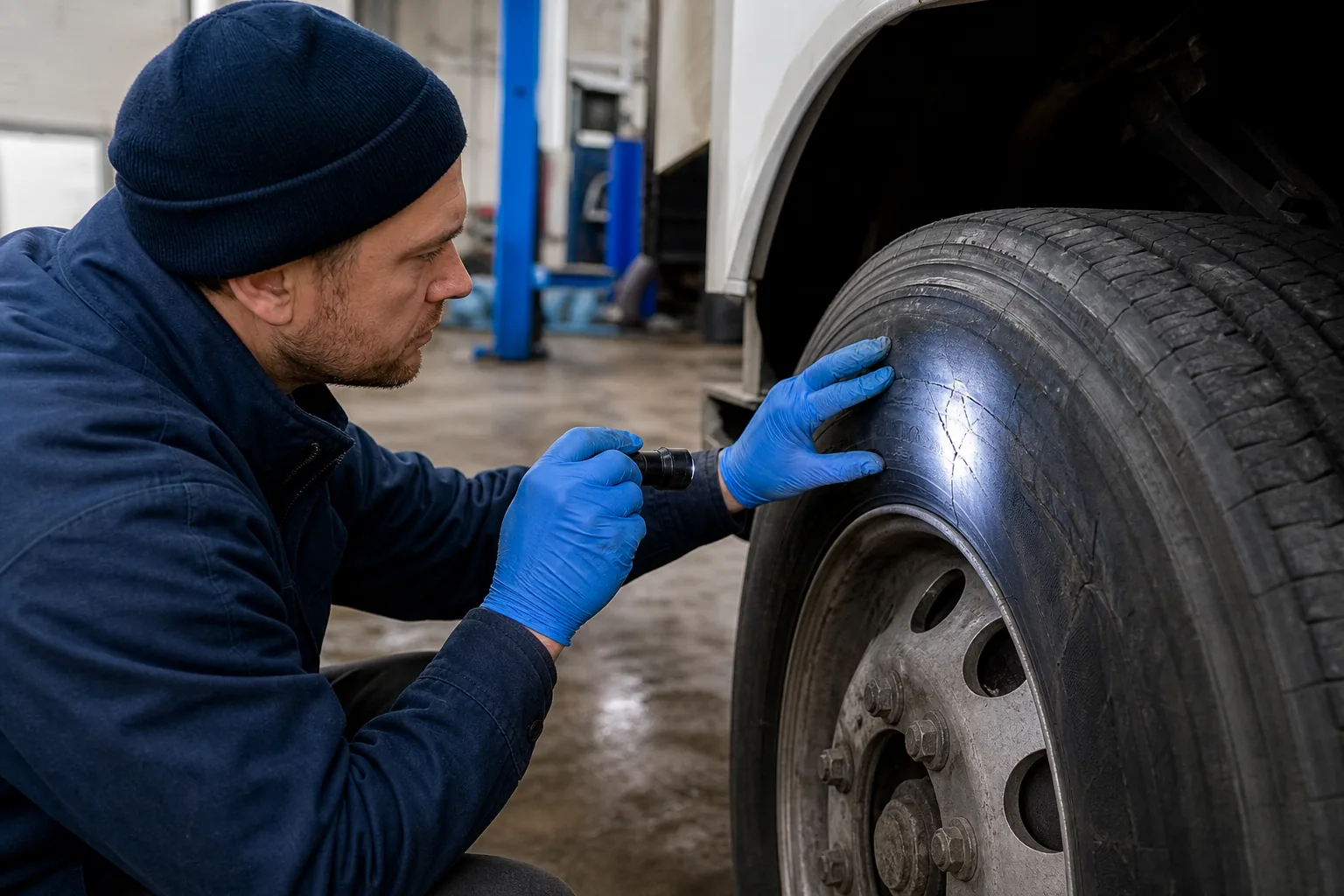
Inspectors treat any visible ply or belt material as an immediate out‑of‑service condition. Look for cuts that go deep enough to expose the cords, bulges that hint at internal delamination, or tread‑carcass separation.
Run your hand along the entire sidewall, from bead to tread shoulder. Feel for soft spots, blisters, or any irregularities. A cut that reveals the steel belt is a definite violation , you must replace the tire before the next trip.
Also watch for tread‑carcass separation. If the tread lifts away from the casing, the tire can blow out without warning. This defect cannot be repaired; it demands a new tire.
Our mobile team carries a portable inspection kit that includes a magnifier, a flashlight, and a handheld camera. We photograph each defect, tag it in the fleet’s maintenance system, and schedule a replacement.
Need tips on fixing a puncture on the spot? Read our Effective Methods for Repairing Large Tires Safely . The guide walks you through plug‑and‑patch techniques that meet DOT standards.
Step 5: Record Tire Age and Arrange Replacement or Mobile Service
The TIN’s last four digits give you the week and year of manufacture. Write that date into your maintenance log for every tire.
Even if tread looks good, a tire older than ten years can suffer internal rubber degradation. Tires should typically be evaluated for replacement after six‑to‑ten years, depending on usage, storage conditions, and manufacturer recommendations.
When a tire hits the age threshold, schedule a replacement before it reaches the legal tread floor. That prevents surprise OOS orders and keeps your CSA score healthy.
If a truck is on the road and a tire fails any of the earlier steps, call us. The Tire Specialist dispatches a technician to your location, inflates, repairs, or swaps the tire, and updates your records in real time.
For fleets that want to compare retread vs. new options, see our Retreads or New Tires Which Is the Smart Choice for Texas Logistics on Hot Roads . It explains approved retread rules.
FAQ
What is the minimum tread depth for steer tires?
Steer tires must have at least 4/32" tread depth. Anything less is out‑of‑service.
How often must I check tire pressure?
Check pressure at least once a week and before every long haul. Cold‑inflation readings give the most accurate number.
Can I use a quick check to verify tread depth?
A quick check only gives a rough idea and cannot prove compliance. Measure tread depth in 32nds of an inch.
Are retreaded tires allowed on all axles?
Retreads are legal on drive and trailer axles, but buses and front‑wheel steer positions have stricter rules. Check the load rating and DOT markings before using a retread.
What documentation do I need during a DOT inspection?
You must have a completed DVIR record that shows sidewall codes, tread‑depth readings, pressure checks, and any defect repairs.
Stay ahead of violations by following these five steps every day. If you need on‑site help, The Tire Specialist can get your fleet back on the road fast.


Comments