
How to Measure Truck Tire Tread Depth
Truck tires lose grip as the tread wears down. If you miss a shallow spot, you risk a violation or an accident. Follow these six steps to get an accurate reading and stay compliant.
Table of Contents
Step 1: Gather Your Tools and Prepare the Truck Safely
First, pick a reliable tread‑depth gauge and use it for accurate measurements.
Make sure the vehicle is parked on level ground, the parking brake is set, and the engine is off. Let the tires cool for at least 15 minutes; a hot tire can give a falsely high reading because the rubber expands.
Safety gear matters. Wear gloves and safety glasses, and make sure your work area is clear and safe.
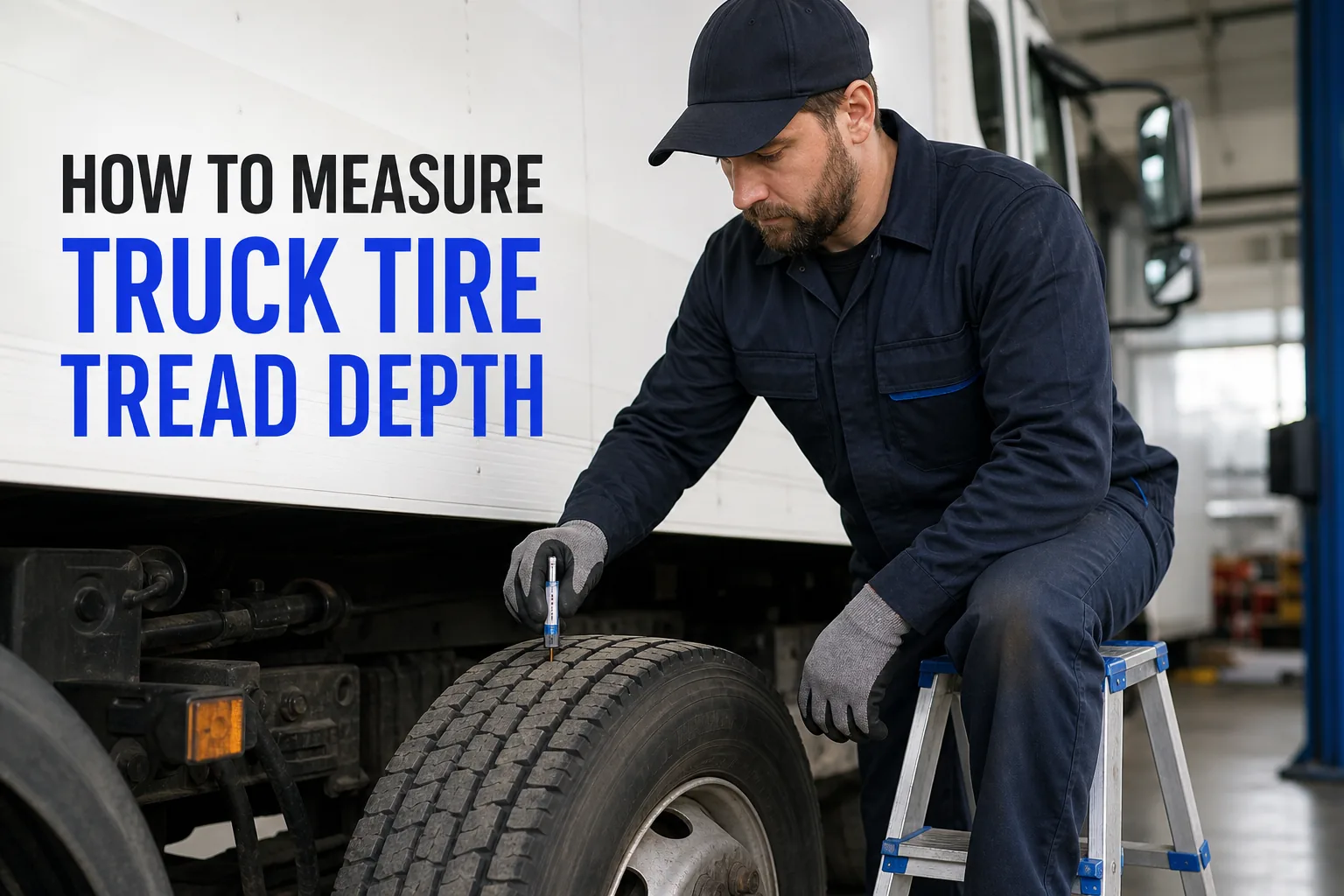
When you’ve got the gauge and the truck is stable, you’re ready for the next step. If you need a quick refresher on the legal minimums, check out our Minimum Tread Depth for Truck Tires: How to Check guide.
Pro Tip:Keep a spare gauge in your truck’s cab. It saves a trip back to the shop.
Step 2: Find a Major Tread Groove and Position the Gauge
Inspect each tire and locate the deepest groove. Measure the shallowest point in a major groove, not the center of the tread.
Place the gauge’s tip at the bottom of that groove. Press it until the shoulders of the gauge sit flat against the tread blocks. This ensures a perpendicular read, which is required by regulation.
Front-wheel tires on a bus, truck, or truck tractor must have at least 4/32 in of tread in a major groove. Except as provided in applicable exceptions, tires must have at least 2/32 in in a major groove. Review the regulation for the exact wording.
Once the gauge is seated, note the reading. If the number is below the applicable minimum, the tire must be replaced before the next trip.
Step 3: Measure Tread Depth at Several Points
A single spot doesn’t tell the whole story. Measure the inner edge, the center, and the outer edge of each tire. Record the lowest number you see.
This practice catches uneven wear caused by mis‑alignment, over‑inflation, or uneven loading. It also helps you compare the measurements with applicable requirements.
For a quick visual reference, the penny test checks the 2/32 in line. Place a penny with Lincoln’s head down in the groove; if you can see the top of his head, the tread is below the legal minimum. The test is fast, but it can’t verify the stricter 4/32 in steer‑tire rule.
When you need a precise figure, use the gauge. It reads in 32nds of an inch and shows the exact depth on a sliding scale.
Here’s how to take the measurement: firmly press the tire tread depth tool into the groove at the identified lowest point. Note the measurement and compare it with the recommended minimum tread depth. A clear readout can make the measurement easier to read.
For a deeper dive on what the tread depth actually represents, see Wikipedia’s explanation of tire tread.
By the end of this step you should have three numbers per tire and a clear idea of which tire is closest to the legal limit.
Step 4: Compare Steer‑Tire and Other‑Tire Measurements
Steer tires control direction and braking, so they carry a higher minimum tread depth. Compare the steer‑tire reading with the drive‑tire readings to see if any front tire is lagging.
Position | Legal Minimum (32nds of an inch) | Typical Replacement Target |
Steer (front) | 4 | 5‑6 |
Drive (rear) | 2 | 3‑4 |
Trailer | 2 | 3‑4 |
If a steer tire reads 3/32 in, it’s already below the DOT floor and will trigger a citation. Even if the drive tires are still above 2/32 in, the truck is non‑compliant because the front tire fails.
For fleets that want a safety buffer, many replace steer tires at 5/32 in and drive tires at 3/32 in. This keeps you clear of both the DOT floor and the stricter CVSA out‑of‑service line.
Our own Semi Truck Steer Tire Tread Depth: How to Check article walks you through a focused steer‑tire inspection routine.
Key Takeaway:The shallowest reading across all points determines compliance, not the average.
Step 5: Check Treadwear Indicators and Uneven Wear
Most commercial tires have built‑in tread‑wear indicator bars placed at the 2/32 in level. When the tread wears flush with these bars, the tire has reached the legal minimum.
Look for at least six evenly spaced bars around the circumference. If any bar is flush, that tire must be replaced immediately.
Uneven wear patterns, such as cupping, feathering, or one side wearing faster, signal alignment or inflation problems. Document the pattern because it helps you pinpoint the root cause.
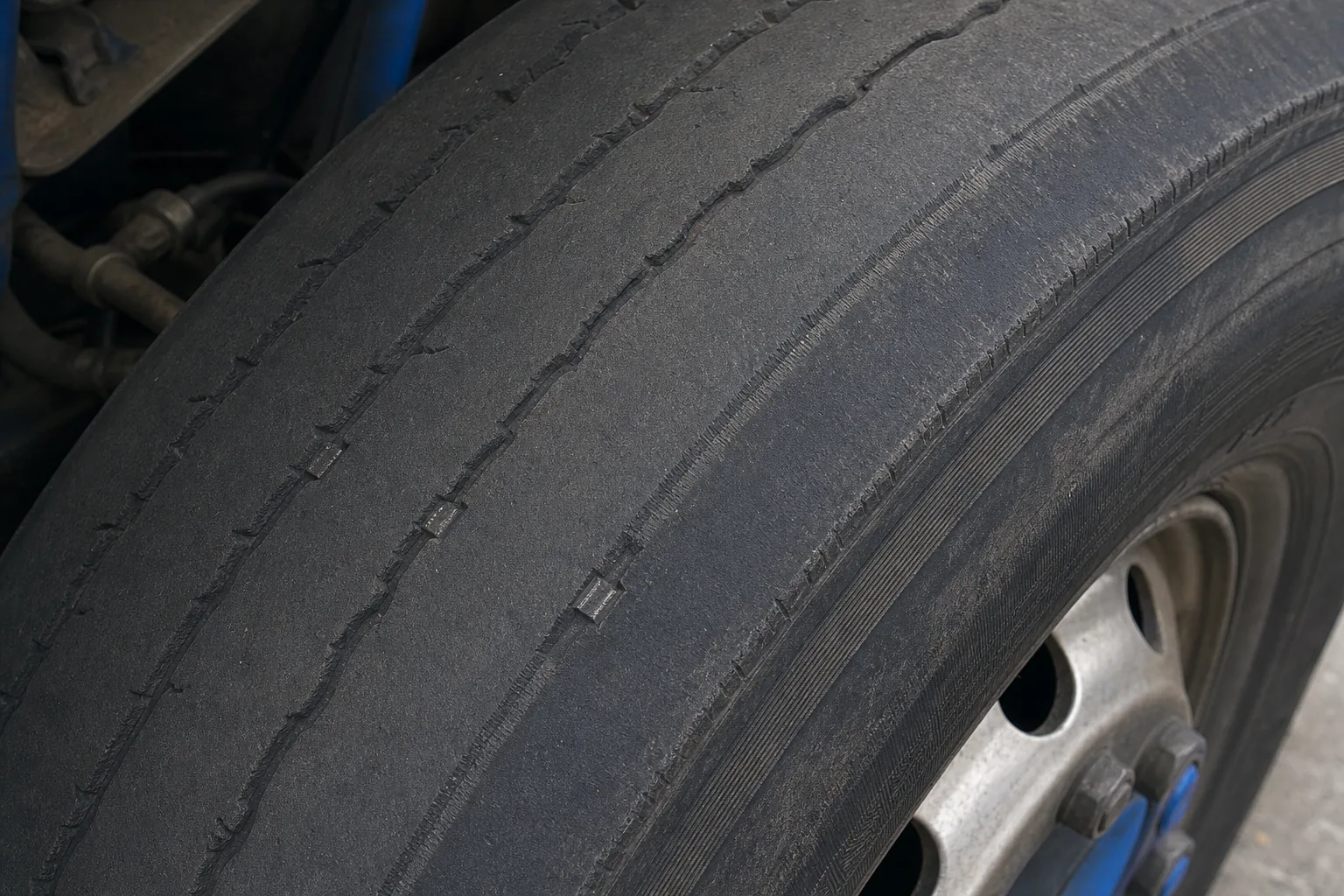
When you spot a problem, note the exact location (inner edge, outer edge, etc.). That detail speeds up the service call and helps the technician fix the underlying issue.
Step 6: Record the Results and Call The Tire Specialist When Needed
Write down each tire’s lowest reading, its position, and any visual clues like wear bars or uneven patterns. Use a simple record or tracking system to keep the data searchable.
Having a record helps during inspections. It shows that you measured each tire in a major groove and logged the numbers.
If any tire falls below its minimum, schedule a replacement right away. Our mobile team can come to your yard, perform the swap, and update the inspection log.
For a full checklist on how to log and track these numbers, see our Truck Tire Inspection Guide: Step‑by‑Step Checklist . We’ll handle the paperwork and the install, so your fleet stays on the road.
Pro Tip:Set up an alert in a maintenance system for any gauge reading that hits 5/32 in on a steer tire. That gives you a proactive window before a violation.
Frequently Asked Questions
What is the legal minimum tread depth for a truck’s steer tire?
The law requires at least 4/32 in (3.175 mm) of tread in any major groove of a steer tire.
Can I use a penny instead of a gauge?
A penny works for a quick check at the 2/32 in line, but it can’t verify the stricter 4/32 in steer‑tire rule.
How is truck tire tread depth measured?
Use a tread-depth gauge or a coin, then compare the reading with the applicable legal minimum for the tire’s position.
Do tread‑wear indicator bars mean my tire is unsafe?
When the tread is flush with the indicator bars, the tire has hit the legal minimum and must be replaced.
What causes uneven wear?
Common causes include mis‑alignment, improper inflation, and uneven loading. Fix the root cause to extend tire life.
Should I replace tires before they reach the minimum?
Many fleets replace steer tires around 5/32 in and drive tires around 3/32 in to stay clear of applicable requirements and CVSA out‑of‑service thresholds.
Staying ahead of wear saves you from costly downtime and fines.
Ready to keep your fleet safe? Call The Tire Specialist for a mobile inspection and replacement service that fits your schedule.


Comments