
Minimum Tread Depth for Truck Tires: How to Check
Truck tires can look fine and still sit below a legal or safe tread limit. The federal rule sets one depth for steer tires and another for most other positions, while wet-road performance can drop before the legal floor.
We’ll show you how to check the tread, spot trouble, and set a replacement point for your fleet. A few U.S. states have no separate commercial tread rule, so the federal standard becomes the baseline.
Table of Contents
Step 1: Learn the Legal and Safe Tread-Depth Limits
Yes, the minimum tread depth for truck tires depends on the wheel position. We start with the federal rule before we inspect any tire.
Under FMCSR 393.75 , tires on the front wheels of a truck, bus, or truck tractor need at least 4/32 of an inch in every major groove. All other tire positions need at least 2/32 of an inch in a major groove.
These measurements don't count spots over tread wear indicators or stone ejectors. A stone ejector is a raised feature in a groove that helps push out trapped debris. Measure beside it, not on top of it.
Tire position | Federal minimum | Safer fleet decision | What to do |
Steer axle | 4/32 inch | Plan replacement before the limit | Remove from service at or below 4/32 |
Drive axle | 2/32 inch | Plan around 4/32 in wet regions | Inspect closely as tread drops |
Trailer axle | 2/32 inch | Use a fleet threshold above the legal floor | Track wear at each inspection |
Federal citations and out-of-service findings aren't always the same thing. A tire may trigger a violation before the vehicle meets the stricter out-of-service condition. That distinction still doesn't make a worn steer tire safe to keep running.
State rules can add confusion. A state-by-state review found no separate tread restrictions listed for Montana, Arkansas, New Mexico, North Dakota, or West Virginia. In each case, the note says the federal minimum may still apply. Treat silence as a reason to check the federal rule, not as permission to run worn tires.

For a quick reference on steer tires, our Semi Truck Steer Tire Tread Depth guide explains the same measurement points in plain terms.
Key Takeaway:Use 4/32 inch for commercial steer tires and 2/32 inch for other positions as the federal compliance floor. Set your replacement plan higher when conditions demand it.
Step 2: Measure Truck Tire Tread Depth Correctly
It’s simple: use a tread-depth gauge when you need a number you can record. Tread depth is the distance from the top of the tread to the base of a groove, measured in 32nds of an inch.
Park on level ground and secure the truck before you begin. Clean stones from the grooves, then check the gauge on a flat surface. The probe should return to zero before each round of readings.
Take several readings
Place the probe in the center of a major groove.
Press the gauge base flat against the tread blocks.
Read the scale without touching the probe.
Repeat near the inner edge, center, and outer edge.
Take readings at several points around the tire.
Record the lowest reading, not just the average. A tire with 6/32 inch in most spots still needs attention if one major groove measures below the required limit.
An analog gauge works well and needs no battery. A digital gauge is easier to read in poor light, but it still needs the same careful placement. A smartphone app can help store inspection notes, yet it cannot replace a physical depth reading.
Coins work as a quick screen. The top of Lincoln’s head on a penny is about 2/32 inch from the edge. The top of Washington’s head on a quarter is about 4/32 inch. These tests can show that a tire is near a threshold, but they don't give the same recordable result as a gauge.
Wear bars provide another fast check. Look for the TWI mark or small arrow on the sidewall. It points to a raised bar inside the groove. When the tread is flush with that bar, the tire has reached about 2/32 inch and needs replacement.
For a fleet, put the reading beside the unit number, axle position, tire position, and inspection date. That record helps a manager spot one tire that is wearing faster than its mates.
Our Truck Tire Inspection Guide can help your drivers follow the same check at each pre-trip inspection.
Step 3: Inspect Wear Patterns and Safety Warning Signs
Yes, tread depth alone isn't enough. A tire can pass a depth check while damage or uneven wear makes it unsafe.
Start with the tread face. If the center wears faster than the shoulders, the tire may be overinflated. If both shoulders wear faster than the center, underinflation may be the cause. Wear on one side can point to alignment trouble or a suspension fault.
Don't adjust pressure based on tread wear alone. Check the truck maker’s load and pressure instructions, then ask a qualified technician to assess the tire and wheel end.
Look for these warning signs
Exposed body ply or belt material.
Tread or sidewall separation.
A flat tire or an audible air leak.
A cut that exposes ply or belt material.
Bulges, deep cracks, or impact damage.
Tread that is flush with a wear indicator.
FMCSR 393.75 addresses several of these conditions. A tire with exposed structure, separation, or an audible leak can lead to a roadside violation and may place the vehicle out of service.
Wet roads add another risk. Grooves move water away from the contact patch. As they become shallow, less water can pass through. Tire maintenance guidance explains that the quarter test checks the 4/32-inch point, which is a useful warning level for wet-road performance, not a universal legal limit. See its tire tread and penny test guidance for the test method.
Testing published by Tire Rack found a pickup with 2/32-inch tires was still traveling 47 miles per hour at the point where the same vehicle with 4/32-inch tires had stopped. That test used a passenger pickup, not a loaded commercial truck, so we should not treat the number as a fleet stopping-distance forecast. It does show why legal minimums are a poor target for wet conditions.
We also check the sidewall and bead area. A deep cut, bulge, or crack can matter even when the grooves look deep. When the cause is pressure, alignment, or a worn suspension part, replacing one tire without fixing the cause can repeat the same failure.
For fleet managers, this is where a fleet maintenance program earns its keep. Give drivers a short checklist, record low readings, and escalate any damaged tire before dispatch.
Step 4: Apply Replacement Guidelines for Weather and Fleet Use
The legal floor tells us when a tire has failed compliance. It doesn't tell us the best time to replace it. For most fleets, 4/32 inch is a sensible planning point when rain, slush, or heavy highway use is common.
Use the reading as a trigger for action:
At 6/32 inch, keep monitoring and check the wear pattern.
At 5/32 inch, review upcoming routes and weather.
At 4/32 inch, plan replacement, especially for wet-road work.
At 2/32 inch, replace tires in positions subject to that federal limit.
At or below 4/32 inch on a steer tire, remove it from service.
Winter tires need special care. Deeper tread helps move snow and slush, so a tire that passes a summer check may not perform well in winter conditions. Check the set before seasonal installation, not after the first storm.
Fleet use changes the decision too. A local truck that returns each night gives you more chances to inspect it. A long-haul unit may travel through rain, cold, heat, and different state rules before it returns. Set its replacement plan before the tread reaches the legal edge.
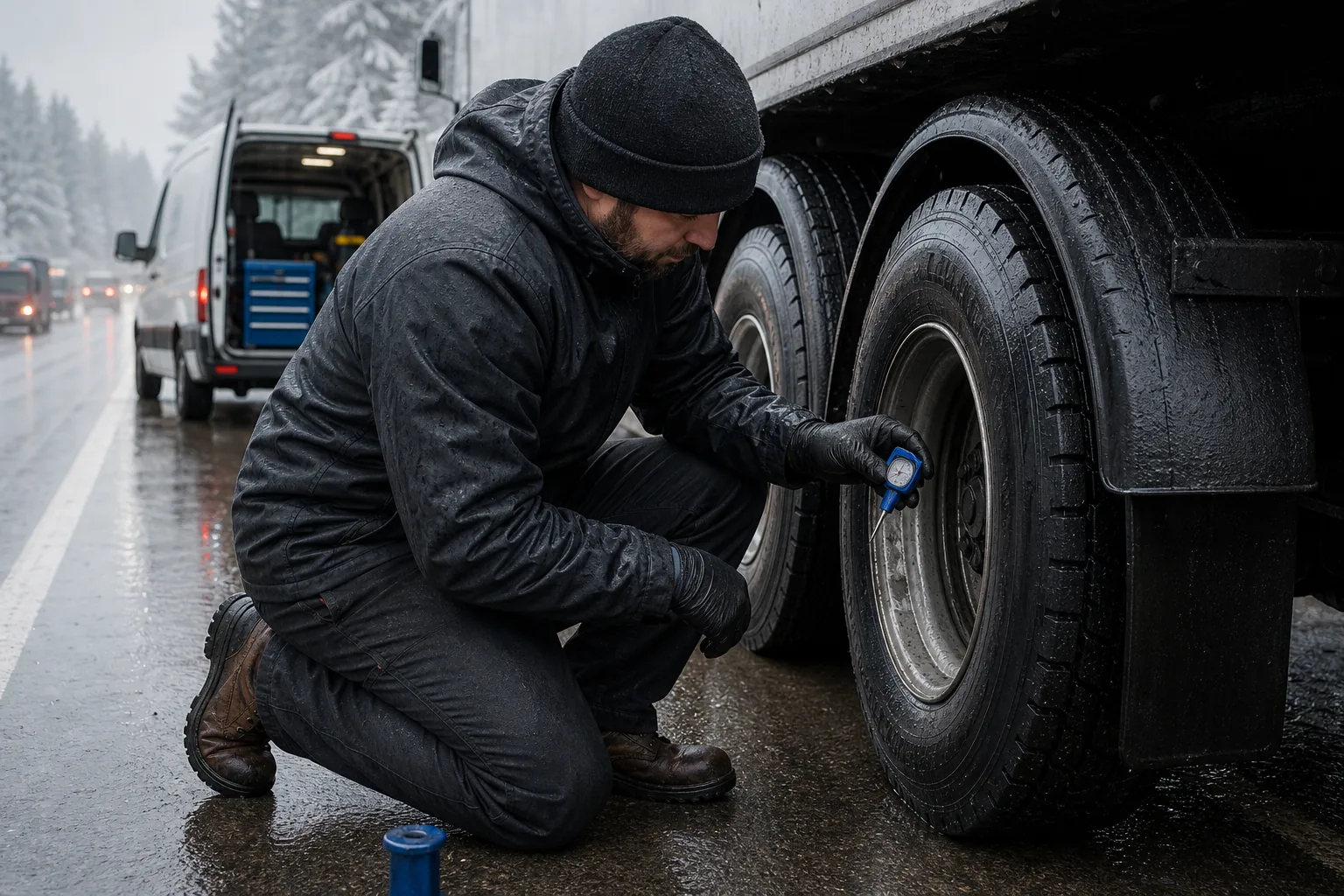
We can help fleet teams plan when to replace truck tires by looking at depth, damage, age, pressure, and route demands together.
Don't wait for a tire to reach 2/32 inch before setting aside a replacement unit. A planned change during a yard visit is easier to manage than an emergency stop during a delivery run.
Step 5: Take Action Before a Tire Becomes Unsafe
Need service? Make the inspection result easy to act on. Mark each tire as safe to run, monitor, schedule, or remove from service.
When a reading is close to a limit, measure again. Check the full tread face and compare the tire with the other tires on that axle. If the readings differ sharply, ask why before the truck returns to work.
For an active tire issue, park the unit safely and keep it out of dispatch until a qualified tire professional checks it. Don't drive on a tire with an exposed belt, separation, serious cut, bulge, or audible leak.
We provide mobile commercial tire service across the Dallas-Fort Worth area through The Tire Specialist . Our team can come to the truck or fleet location for on-site tire replacement, repair assessment, and roadside help. That can reduce the time a driver spends waiting beside a disabled unit.
For recurring wear, add these items to the maintenance record:
Depth by tread position.
Inflation pressure at inspection.
Axle and tire position.
Visible damage or wear pattern.
Next action and due date.
Use the record during weekly fleet reviews. If several trucks show shoulder wear, the issue may be a pressure process. If one axle shows one-sided wear, inspect alignment or suspension before fitting more tires.
We’ll give you a clear service assessment when the next step needs expert help. The Tire Specialist is a useful partner when a tire cannot wait for the next shop visit.
FAQ
What is the minimum tread depth for truck tires?
The federal minimum is 4/32 inch for commercial truck steer tires and 2/32 inch for most other tire positions. Measure in a major groove and avoid wear bars or stone ejectors. These are compliance limits, not ideal replacement targets. Many fleets plan replacement near 4/32 inch when wet roads are common.
Is 4/32 tread depth safe for a truck tire?
At 4/32 inch, a truck tire may have useful tread left, but the answer depends on its position and condition. It is the federal minimum for a commercial steer tire, so it should not run below that point. For drive or trailer tires, 4/32 inch is often used as a planning threshold for wet-weather work.
How do you measure commercial truck tire tread depth?
Use a calibrated tread-depth gauge in a major groove, with the gauge base flat against the tread blocks. Measure near the inner edge, center, and outer edge. Repeat around the tire, then record the lowest reading. A penny or quarter can screen for wear, but a gauge gives the better fleet record.
Can a truck tire pass the tread test and still be unsafe?
Yes, a truck tire can pass a depth check and still be unsafe. Look for exposed cords, separation, cuts, bulges, cracks, or an air leak. Uneven wear can also point to pressure, alignment, or suspension problems. Depth is one part of the inspection, not a substitute for checking the whole tire.
When should fleet managers replace truck tires?
Fleet managers should plan replacement before a tire reaches its legal limit. Use about 4/32 inch as a review point for wet routes, and replace commercial steer tires at or below 4/32 inch. Replace other positions at or below 2/32 inch. Move sooner when damage or uneven wear appears.
Conclusion
Use 4/32 inch as the steer-tire floor and 2/32 inch for most other commercial positions, but plan replacement sooner when rain, snow, or uneven wear raises the risk. Measure each tire with a gauge, record the lowest reading, and contact The Tire Specialist when a Dallas-Fort Worth truck needs on-site tire help.


Comments