Commercial Truck Tire Maintenance: A Step‑by‑Step Guide
Every mile a truck rolls, the tires bear the load and the road. Miss a problem and you risk downtime, fines, or worse. Below is a hands‑on routine that lets you keep every tire in shape and stay on schedule.
Table of Contents
Step 1: Set a Regular Tire Inspection Routine
First, decide how often you’ll look at each tire. Most fleets run a weekly visual walk‑around, a monthly deep check, and a quarterly audit that feeds into a digital log. A consistent cadence catches wear before it becomes a blowout.
Start by assigning a responsible crew member, a driver can do the quick walk‑around, a mechanic handles the monthly gauge‑read and tread‑depth test. Capture the data on a tablet or a shared log. That way you get a history for each axle and can spot trends.
A regular schedule helps catch wear before it becomes a blowout. Under‑inflated tires can raise rolling resistance. For more information, see this resource.
Tip: use a printable checklist for pre‑trip inspections. When the list lives on a phone, drivers spend seconds, not minutes, each shift.
Key Takeaway:A three‑layer inspection (weekly, monthly, quarterly) turns random tire failures into predictable maintenance events.
We keep the schedule simple: Semi Truck Tire Maintenance: A Step‑by‑Step Guide walks you through a simple routine you can repeat.

Step 2: Check Tire Pressure and Inflate for the Load
Pressure is the single biggest factor in tire life and fuel use. Measure when the tires are cold, after the truck has sat at least three hours. Use a calibrated digital gauge; analog gauges drift and can mislead by five psi.
Refer to the manufacturer’s side‑wall spec, then adjust for load and temperature. A rule of thumb: add 1 psi for every 10 °F rise above the baseline. Over‑inflation can cause a harsh ride and a bulge; under‑inflation spikes rolling resistance and heat, which leads to tread wear.
Record the reading, the ambient temperature, and the load being carried. Our on‑site technicians at The Tire Specialist record every figure, so you can compare today’s numbers with last month’s and spot a slow leak.
When a tire reads low, add air in short bursts and re‑check. If the pressure climbs back down within a day, schedule a leak‑check, a puncture or valve issue may be the cause.
Pro Tip:Keep a spare calibrated gauge in each cab; drivers can correct pressure before hitting the highway.
Our mobile crew can bring the equipment to your job site and set every tire to the right pressure before the truck leaves.
Step 3: Check Tread, Damage, and Dual‑Tire Clearance
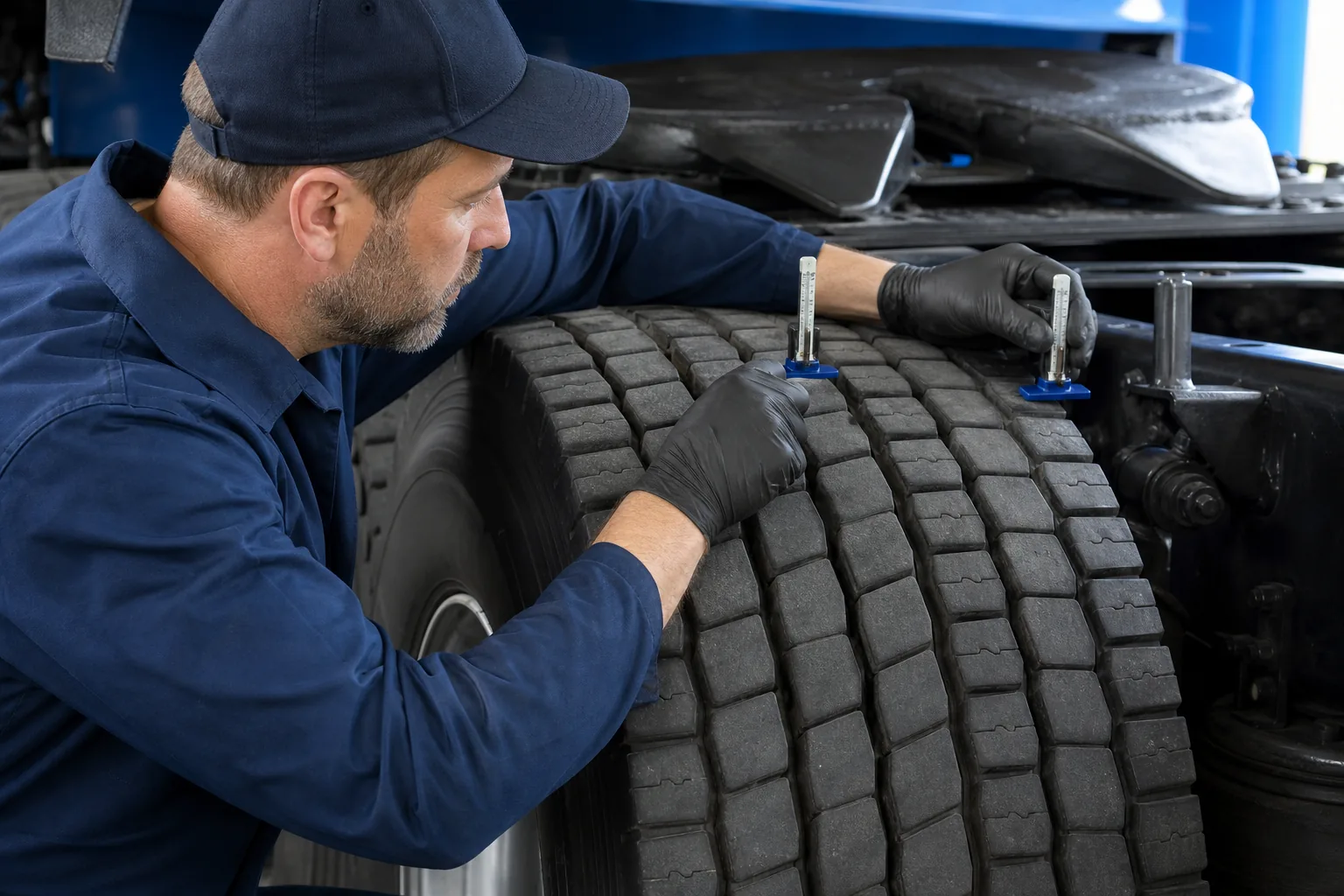
Next, measure tread depth with a gauge. Many fleets aim for 6/32″ on steer tires to give a buffer against CVSA out‑of‑service (OOS) thresholds.
Run the gauge at three points on each tire, inner shoulder, center, outer edge, and note the lowest reading. Log the figure; a drop of two‑thirds of an inch over a month signals uneven wear, often from alignment or over‑loading.
Inspect the sidewalls for cuts, bulges, or exposed cords. Even a small sidewall crack can become a catastrophic failure if the tire is loaded heavily.
For dual‑tire setups, verify that both tires share the same pressure and that the clearance between them meets manufacturer specs. Unequal pressure can cause one tire to carry more load, accelerating wear and increasing the risk of a blowout.
Key Takeaway:Consistent tread and sidewall checks help you avoid CVSA out‑of‑service orders.
Need a quick refresher on how to read tread gauges? Minimum Tread Depth for Truck Tires: How to Check breaks it down in a one‑minute video.
Step 4: Record Findings and Address Problems Promptly
After each inspection, enter the data into a digital DVIR system. The record must include unit number, axle position, pressure reading, tread depth, and any damage notes. A signature from the driver or technician seals the entry.
Why digital matters: A paper log often misses a defect, but an electronic record sends an instant alert to your maintenance manager.
If the DVIR flags a low tread or a sidewall bulge, schedule a repair or replacement within 24 hours. Our TIA‑certified techs can come on‑site, replace the tire, balance the wheel, and update the log before the truck hits the road again.
Track trends over time. When a particular axle repeatedly shows shallow tread, investigate alignment or load distribution. Proactive adjustments prevent a cascade of premature failures.
Finally, keep searchable records. During a DOT audit, inspectors will ask to see the logs; a clean, searchable history shows compliance.
Pro Tip:Set automated email alerts for any DVIR entry that falls below 6/32″ on steer tires, you’ll catch problems before they trigger an OOS order.
Our customized fleet maintenance program keeps that history in one place, so you always know which tires need attention.
Frequently Asked Questions
How often should I inspect commercial truck tires?
You should do a visual walk‑around weekly, a detailed pressure and tread check monthly, and a full audit each quarter. That three‑tier schedule catches most issues early.
What is the legal minimum tread depth for steer tires?
Check the applicable requirements for your operation.
Can I rely on TPMS alerts alone?
No. TPMS helps you see sudden pressure loss, but it doesn’t measure tread depth or sidewall damage, so manual checks are still required.
What penalties do I face for a tire OOS violation?
Tire OOS violations can disrupt operations. Prompt DVIR entries help you address issues early.
Do I need a certified technician for tire repairs?
Our TIA‑certified techs can help with tire repairs.
How does The Tire Specialist help with fleet tire maintenance?
We offer 24/7 on‑site service, TIA‑certified technicians and a customized fleet maintenance program that keeps every inspection, pressure check and repair on record.
Conclusion
Stick to the four‑step routine, schedule inspections, check pressure, measure tread, and log everything, and you’ll keep your trucks moving safely. Ready to simplify the process? Reach out to The Tire Specialist and let our mobile crew put the plan into action today.


Comments